
The artist
Joslyn Walker-Peart
Jamaican-born artist, political thinker and lifelong student whose work explored slavery, migration, identity, landscape and the Black experience.
- 1923–2008
- Acrylic on canvas
- 25 works in the collection
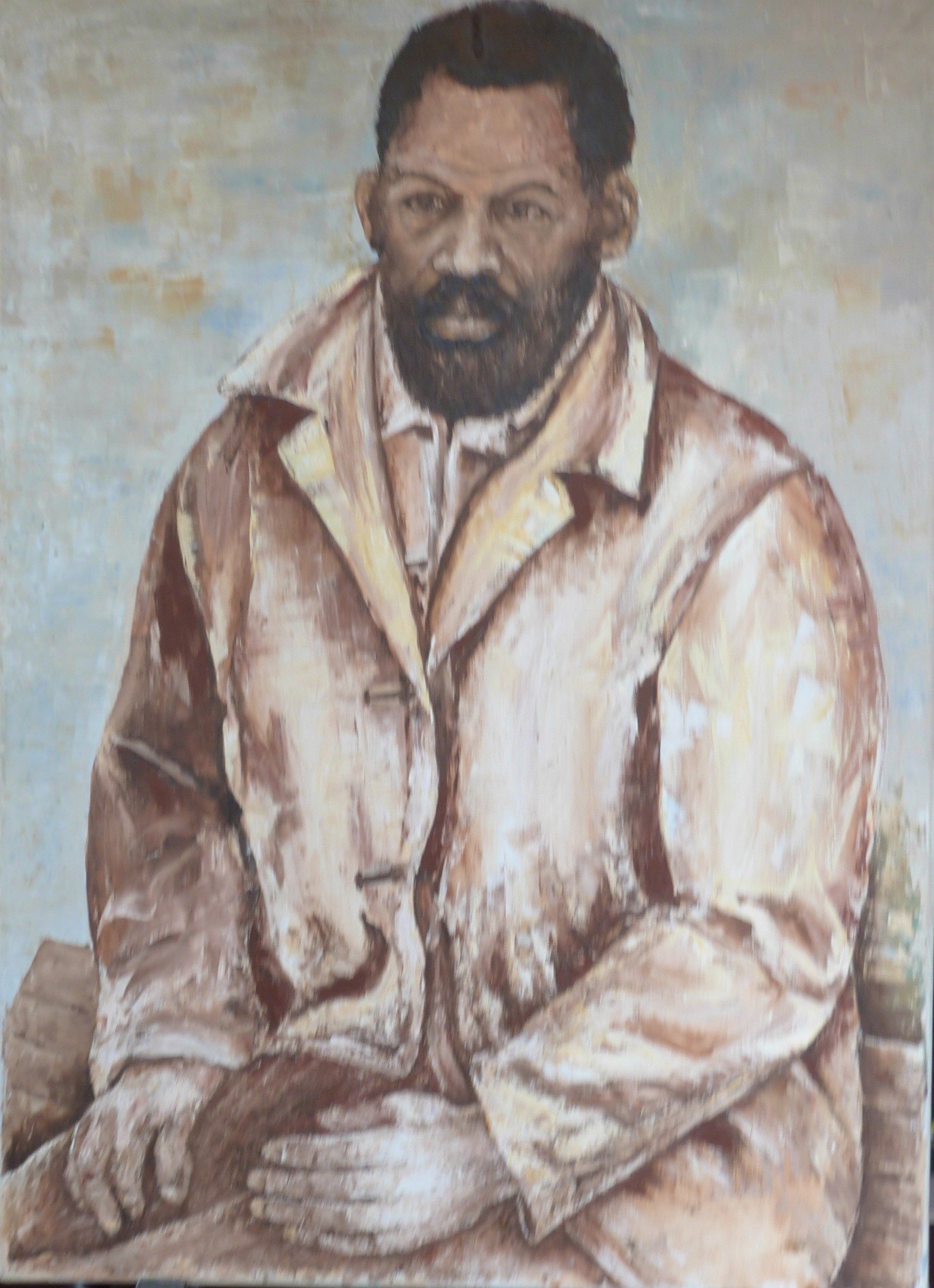
“There is only one race — the human race.”
Early life
Joslyn Walker-Peart was born in 1923 and began life up in the hills above Kingston, Jamaica. The landscape of that childhood — the greens, the heat, the distances — returns repeatedly in the paintings he made half a century later and thousands of miles away.
Precise birthplace and family details to be confirmed by the client.
Migration and Britain
During the Second World War he answered the call to work the fields and plantations of South Carolina. He was then among the first to answer the call to the “Motherland”, leaving on the Empire Windrush and going to work at the BSA factory in Birmingham, building bikes and guns, in his own phrase, “to sell back to the Empire”.
He soon realised that the reality of life in England was not exactly a level playing field for West Indians. This was the age of Enoch Powell and the “Rivers of Blood” speech, and the experience shaped both his politics and his painting.
Politics and education
Jos was deeply involved in Birmingham racial politics and understood both sides of the argument. A committed autodidact, he was very well read, took many Open University courses, and had little patience with the nihilism he saw in the Rude Boys of the time.
“There is only one race — the human race,” he would cry. His final day job was as stage manager for the Birmingham Symphony and Conservatoire.
Life in Herefordshire
He moved to Ross-on-Wye, on the edge of the Forest of Dean, to reflect, read and paint, living alone but content, and wanting to learn classical guitar.
There he painted and painted in large-scale acrylics, from overtly stark images of eighteenth and nineteenth century slavery to pastoral scenes of the Forest of Dean and Herefordshire.
Friendship with Pete Goodall
The friendship began with a telephone call: a Jamaican accent asking a guitarist living in deepest Herefordshire whether he gave guitar lessons. Pete Goodall visited every week for seven years, and was the only person with Jos at his death. They talked and talked every Thursday morning, and Jos may just have learned to play a little Bach and Carulli.
“I learned more Black history from my dear friend than years on the road in very mixed-race bands,” Pete writes. Jos bequeathed the paintings to him with the instruction that his 25 images of slavery, from Africa through the triangular trade to Jamaica, be used as the basis for “a proper education of the diaspora”.
The 25-painting collection
At the centre of his legacy are 25 paintings tracing a journey from Africa, through the transatlantic triangular trade, plantation life and Jamaica. They were made as a sequence, and they are strongest read as one.
The original 2020 exhibition
Through Pete Phillips, and then Jos Brient at the Azawala gallery in Brixton, the paintings found a circle of Afro-Caribbean poets who wrote in response to them. The project launched at Azawala two weeks before lockdown in 2020, and the tour was cancelled.
“To write to a painting by someone you've never met is not something I could ever do,” Pete Goodall says of the poets. “They are all brilliant.”
Creative Encounters 2026
Brixton Tate's enthusiasm to exhibit the 25 paintings as their centrepiece for Black History Month 2026, for the whole of October, encouraged Pete to resurrect the project as Tunakupenda, with workshops for young people in art, music and poetry drawing on the paintings as their theme.
The exhibition runs from 2 to 30 October 2026, with a Private View on Tuesday 6 October featuring live poetry and music.
Legacy and future tour
Following Brixton, Tunakupenda plans a UK tour, particularly visiting towns and cities with an underprivileged diaspora and a high cultural deficit, building a national database of art, music and poetry recorded and collected along the way, with a finale at the Edinburgh Festival in 2027 — followed, of course, by another tour.
Touring venues are aspirations, not confirmed bookings.
Timeline
- 1923Born in the hills above Kingston, Jamaica
- 1940sWartime work in the fields of South Carolina
- 1948Sails on the Empire Windrush; works at the BSA factory, Birmingham
- Birmingham yearsRacial politics, Open University study, stage manager for the Birmingham Symphony and Conservatoire
- c. 1988Moves to Ross-on-Wye to read, reflect and paint
- 2008Dies, leaving 25 paintings to Pete Goodall
- 2020Launch at Azawala gallery, Brixton, two weeks before lockdown
- 2026Creative Encounters, Brixton Tate Library
- 2027Planned tour finale, Edinburgh Festival
Dates marked in general terms await confirmation by the client.
View the collection“A proper education of the diaspora.”